
Mole Removal in Penang: What to Check Before a Mole Comes Off
Mole removal in Penang is easy to book, but the safe order is to check the mole first and remove it second. This guide is for anyone who wants a mole taken off, whether for looks, comfort or worry. You will learn the warning signs, how each removal method works, why the lab test matters, and what to ask about scars and cost.
Most moles are harmless
A mole is a small cluster of pigment cells in the skin. Doctors call it a melanocytic naevus. Most moles are harmless, and you can safely leave them alone.
Even so, people have good reasons to want one removed. DermNet lists three: to rule out cancer, because the mole gets irritated, or for looks. A mole on the jawline may catch on a razor, for example. A raised mole under a bra strap may rub and bleed. If the growth is soft, skin-coloured and hangs on a stalk, it may be a skin tag instead. Our guide to skin tag removal in Penang covers those.
The reason matters, because it changes who you should see and which method suits. A mole removed for looks can often go to a GP or aesthetic doctor once it has been checked. However, a mole that worries you should go to a dermatologist first.
Check the mole first: warning signs
Doctors use a simple checklist called the ABCDEs. The Skin Cancer Foundation describes it like this:
- A, asymmetry: the two halves do not match.
- B, border: the edge is uneven, notched or blurred.
- C, colour: more than one shade of brown, tan or black.
- D, diameter: about 6 mm or wider, roughly the size of a pencil eraser. A spot that is darker than your other moles also counts.
- E, evolving: any change in size, shape, colour or height, or new bleeding, itching or crusting.
Also look out for the "ugly duckling". This is a mole that looks different from all your others. DermNet adds that a new mole in an adult over 40 deserves a check too.
The NHS gives similar advice. See a doctor if a mole changes size, shape or colour, becomes painful or itchy, or is inflamed, bleeding or crusty.
Where to look in Asian skin
Many people only check their face and arms. In darker and Asian skin, however, melanoma often grows where the sun rarely reaches. The American Academy of Dermatology (AAD) names the palms, soles, fingers, toes, nails, mouth and genitals.
For example, a study of 142 Chinese patients with melanoma on the hands and feet found that most cases were on the foot. The sole was the single most common site, and 16% started under a nail. The median time from first noticing a change to diagnosis was almost two years.
So check your soles and nails once a month. A dark streak in a nail can look like a bruise. Unlike a bruise, though, the AAD says it does not grow out with the nail. A growing dark spot on a palm or sole also needs a doctor.
Four methods of mole removal in Penang clinics
There are four main methods. The right one depends on the mole's shape, depth and whether it looks suspicious.
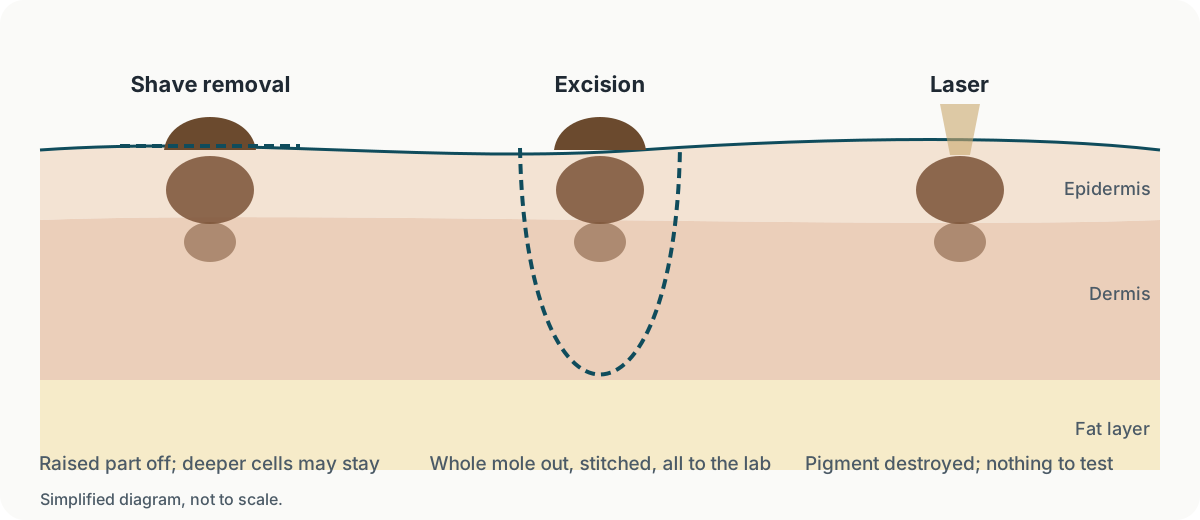
Excision. The doctor numbs the skin with an injection, cuts out the whole mole with a margin of normal skin, and closes the wound with stitches. DermNet says doctors use this for flat or suspicious moles. Stitches come out after 4 to 14 days.
Shave removal. The doctor shaves a raised mole level with the skin using a blade. This suits moles that stick out. However, deeper cells can stay behind, so the mole may come back.
Electrosurgery. Heat from an electric current destroys or removes the tissue. DermNet lists it among the surgical options. Ask whether any tissue will go to the lab.
Laser. A laser destroys the pigment and tissue. It can suit small, flat moles that a doctor is confident are harmless. But it leaves no tissue to test.
| Method | Best suited to | Tissue sent to the lab | Scar | Chance of regrowth |
|---|---|---|---|---|
| Excision | Flat or suspicious moles | Yes, the whole mole | A fine line that fades over months | Lower, as the whole mole comes out |
| Shave removal | Raised moles | Yes, the part removed | A small mark | Higher: 13–26% in studies |
| Electrosurgery | Some raised moles and growths | Ask the doctor | A small mark | Ask the doctor |
| Laser | Small flat moles already judged harmless | No | Usually small, but heat can scar | Common, as deeper cells survive |
Why the lab test matters
When a doctor sends a mole to the lab, a pathologist looks at it under a microscope. The AAD says this is part of normal mole removal. If cancer cells turn up, the dermatologist will tell you.
This step catches things the eye can miss. In one study quoted in a 2014 review, 2.3% of moles that looked harmless were found to be cancerous under the microscope. For this reason, the review's authors advise that every removed mole should go to the lab.
So ask any clinic offering mole removal in Penang whether it sends tissue to a lab. Laser removal skips this step completely. The same review notes that pigment often returns after laser, because the deeper mole cells are shielded from the beam. In addition, a regrown mole can look abnormal under the microscope, which makes a later diagnosis harder.
The AAD adds a clear rule: if a removed mole grows back, see your dermatologist straight away. Regrowth can be harmless, but it can also be a sign of melanoma.
Never remove a mole at home
Mole removal creams, pens and "DIY" kits are easy to find online. The AAD warns against them. Cancer cells can stay in the skin and spread. Home removal can also scar or infect the skin, and it can delay the diagnosis of a skin cancer.
Dermatologist or aesthetic doctor for mole removal in Penang
In Malaysia, a dermatologist is a specialist listed on the National Specialist Register (NSR) in dermatology. An aesthetic doctor is a registered doctor, usually a GP, who should hold a Letter of Credentialing and Privileging (LCP) from the Ministry of Health for aesthetic procedures. You can search any doctor on the Malaysian Medical Council register and any specialist on the NSR.
A simple rule works well for mole removal in Penang. If the mole is changing, new after 40, bleeding, on a sole, palm or nail, or you are simply unsure, see a dermatologist first. In our top 10, Lim Skin Specialist Clinic and the Gleneagles Hospital Penang dermatology service are led by consultant dermatologists. A dermatologist can examine it with a dermatoscope, a lit magnifier that shows patterns under the surface. They can also take a biopsy.
On the other hand, if a doctor has checked the mole and judged it harmless, cosmetic removal at a GP-led or aesthetic clinic is a reasonable choice. For example, Dr Skin & Hair is a GP-led clinic that lists minor removal and skin biopsy. Even then, ask whether the clinic will send the tissue to a lab.
Our skin treatments in Penang hub lists the clinics that offer mole and growth removal. You can also read how we tell specialists and aesthetic doctors apart in our editorial policy.
Scars, keloids and regrowth in Asian skin
Every method leaves a mark of some kind. After excision, the scar starts red and raised. DermNet says it usually fades in colour and size over several months. Doctors often line the cut up with natural skin creases to make it less visible.
Keloids are the bigger worry for many people in Penang. A keloid is a thick scar that grows beyond the wound. DermNet says keloids are more common in darker skin types, and in people of Chinese descent in particular. The upper chest, shoulders, ears and neck are the most prone areas, and surgery is a known trigger.
So if you have had a keloid before, tell the doctor before any removal. For a mole on the chest or shoulder, it is fair to ask whether removal is worth the scar risk. You can also ask how the doctor would treat a keloid if one forms.
Dark marks can also follow any skin injury in Asian skin. Our guide to pigmentation treatment in Penang explains how these marks usually fade, and why sun protection helps.
What to expect: before, on the day and after
The steps for mole removal in Penang follow general dermatology practice.
Before. The doctor asks how long you have had the mole and whether it has changed. They examine it, often with a dermatoscope. Then they explain the method, the likely scar and whether the tissue goes to the lab. Mention any blood thinners, past keloids or allergies to local anaesthetic.
On the day. An injection quickly numbs the area before the doctor starts. According to the AAD, most removals need only one visit.
After. DermNet's wound advice for an excision is simple:
- keep the dressing on and the wound dry for 48 hours, then wash it gently
- expect tenderness for a few hours as the numbing wears off
- avoid heavy exercise and stretching the area until the stitches are out
- return for stitch removal, usually 4 to 14 days later
- ask when and how you will get the lab result
Red flags after removal. Press firmly on any bleeding for 20 minutes. If it does not stop, get medical help. Also see the doctor promptly if redness or pain gets worse, because the wound may be infected. Finally, book a check if the mole grows back.
What mole removal in Penang costs, and what to ask
None of the clinics on our list publishes a mole removal price on its own website, as of November 2026. We do not guess at numbers. Instead, ask for a written quote that covers:
- the consultation fee
- the removal itself, and whether the price changes with size or number of moles
- the lab (histology) fee
- stitches, dressings and the stitch-removal visit
- a follow-up visit to discuss the lab result
- what happens, and what it costs, if the mole grows back
A mole that a doctor suspects is cancerous is a medical problem, not a cosmetic one. If you have health insurance, ask your insurer whether a medically needed removal and lab test are covered.
Clinics for mole removal in Penang
These clinics from our top 10 list mole removal, skin growth removal or lesion assessment on their own websites. The notes use only facts from our clinic research. None publishes a mole removal price.
No. 2: Lim Skin Specialist Clinic
Consultant dermatologists, George Town
Led by consultant dermatologists on the National Specialist Register. Lists skin cancers and growths, skin surgery, cryosurgery, electrosurgery and an ablative laser for growths. A good first stop for a changing or worrying mole.
No. 10: Gleneagles Hospital Penang (Dermatology)
Hospital dermatology, George Town
Hospital dermatology service with sessional dermatologists. Lists skin cancer among the conditions it treats, plus laser treatment for pigmented lesions.
No. 1: Dr Skin & Hair
GP-led medical skin clinic, Green Lane & Bayan Lepas
GP-led medical skin clinic that does not use lasers. Lists assessment of lumps and bumps, with minor removal and skin biopsy where needed.
No. 3: O2 Clinic
GP-led aesthetic group, Ayer Itam + 11 branches
GP-led group with aesthetic services. Lists removal of moles and skin lesions, and GP-level care for skin tags, warts and suspicious skin growths.
No. 5: A Klinik Signature
Aesthetic doctor clinic, Green Lane, Jelutong
Aesthetic clinic that lists mole, cyst, milia and keloid removal.
No. 7: THE K KLINIK
Aesthetic physician clinic, Jalan Kelawai, near Gurney
Aesthetic clinic that lists laser removal of benign moles, skin tags and milia. Best for moles a doctor has already judged harmless.
No. 9: IDO'S Clinic
Aesthetic laser chain, Bayan Lepas (Bay Avenue)
Aesthetic and laser chain that lists removal of moles and benign skin growths.
If you are unsure where to start with mole removal in Penang, see a dermatologist for the check, then decide on removal. Each clinic review on our site shows which doctors on the team are specialists.
Mole removal in Penang: common questions
Is laser mole removal safe?
Laser can suit a small, flat mole that a doctor has examined and judged harmless. Its main drawback is that it destroys the tissue, so no lab can check it. Pigment also comes back fairly often. For any mole that has changed, ask for excision or a biopsy instead.
Does mole removal leave a scar?
Yes, every method leaves some mark. An excision scar is a fine line that fades over several months, while a shave leaves a smaller mark. People who form keloids, and moles on the chest, shoulders or ears, carry a higher scar risk.
Can a mole grow back after removal?
It can, most often after shave or laser removal, because some mole cells sit deeper in the skin. A regrown mole is often harmless. Still, the AAD advises seeing a dermatologist promptly, because regrowth can be a sign of melanoma.
How much does mole removal in Penang cost?
We could not find a published mole removal price from any clinic on our list. The total depends on the method, the size and number of moles, and whether a lab test is needed. Ask for one written quote that includes the lab fee and follow-up visits.
Do I need a dermatologist to remove a mole?
Not always. A GP or aesthetic doctor can remove a mole that has been checked and looks harmless. However, a mole that is changing, bleeding, new after 40, or on a sole, palm or nail should be seen by a dermatologist first.
Is a dark line on my nail a mole?
Many dark nail streaks are harmless, but a new or widening streak needs a doctor's check. In Asian skin, melanoma can start under a nail. Unlike a bruise, a melanoma streak does not grow out as the nail grows.
Sources
- Moles: diagnosis and treatment – American Academy of Dermatology
- Melanocytic naevus – DermNet
- Moles – NHS
- Optimal management of common acquired melanocytic nevi (moles): current perspectives (Sardana, Chakravarty and Goel, 2014) – Clinical, Cosmetic and Investigational Dermatology
- Skin cancer in people of color: melanoma – American Academy of Dermatology
- Do you know your ABCDEs? – Skin Cancer Foundation
- Acral melanoma in Chinese: a clinicopathological and prognostic study of 142 cases (Lv et al., 2016) – Scientific Reports
- Keloids and hypertrophic scars – DermNet
- Excision of skin lesions – DermNet
Related reading
All skin treatments in Penang
Lasers, peels, injectables and medical dermatology, with the clinics that offer each.
Pigmentation treatment in Penang
Melasma, freckles and dark spots: creams, peels and lasers, and the clinics to see.
No. 2: Lim Skin Specialist Clinic
Consultant dermatologists in George Town
Looking for a clinic? See our skin clinic Penang top 10, or browse all skin guides.
This guide is general information, not medical advice. Always see a registered doctor about your skin. Read our full disclaimer.